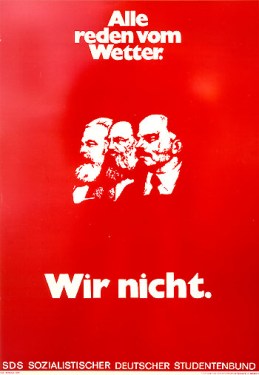
Not talking about the weather

index

Since there won’t be any pictures in my book, I thought I’d use this blog to show a few important images from the story of Germany’s 1968 generation – some of which I mention in the book. To begin with, here’s the famous 1960s poster whose visual style also influenced the cover of my book a little. The caption reads: “Everyone’s talking about the weather. We aren’t”. It’s an iconic image in Germany – it’s actually in the Haus der Geschichte, the German national history museum, in Bonn – but is little known in the UK or the US. The first time I saw it – and, I think, the first time I heard about the West German student movement – was when Iived in Berlin in 1992 with a guy who had grown up in East Germany and had a black and white photocopy of it on his bedroom wall.

Thoughts on Israel

Post-Zionist graffiti
Originally uploaded by Hans Kundnani.

Since I visited Israel for the first time in April, I’ve been thinking a lot about where legitimate criticism of Israel ends and anti-Semitism begins. I’m currently reading an excellent German anthology (includes essays by Tony Judt, Jeffrey Herf, Gerd Koenen etc.) on the debate about whether there is such a thing as a “new anti-Semitism” (especially on the European left but also in the Islamic world). It’s a theme that also runs through my book, Utopia or Auschwitz, which tells the story of Germany’s 1968 generation. In fact, the book is among other things a case study of how one small group of people went from criticising Israeli policy to attacking Jews.

Continue reading

Random thoughts on the German language

Favourite word: generalstabsmäßig – General Staff-like, as in with military precision
Weirdest phrase: ein inner Reichsparteitag – an inner Nuremberg rally, as in a private celebration of the triumph of the will
Most useful word that doesn’t exist in English: Auseinandersetzung
Most evocative word: Mandel – see Paul Celan
Nicest-sounding word: Schmetterling – butterfly
Most annoying Fremdwort – foreign word: Handy – mobile
Philosophically weirdest word: aufheben – see Hegel
Existentially most interesting word: Freitod – suicide = free death
Most important word for understanding Germany: Geist – mind/spirit

Utopia or Auschwitz in 13 sentences

They were the children of murderers. They were revolutionary optimists. They went from protest to resistance. But within them was an abominable irrationalism. The struggle continued. They went on a death trip. But they were given a lifeline. They made peace. There was a new republic. They won power. They fought a war against the past. History returned. They found a German way.

New German theories of colour

Back in 1985, the Social Democrats and Greens in the state of Hesse formed the first ever “red-green” government in German politics. When it collapsed less than two years later, it seemed destined to be a footnote in German political history. In fact, it turned out to be the prototype for a string of other “red-green” governments and ultimately for the national government under Gerhard Schröder in 1998. In the city-state of Hamburg the Christian Democrats and Greens are currently negotiating an agreement to form a “black-green” coalition under Ole von Beust that may eventually re-draw Germany’s political map in a similar way to that first “red-green” experiment. It also parallels other recent attempts elsewhere – for example by David Cameron in the UK and by former Bush speechwriter David Frum in the US – to formulate Green conservatism.

Continue reading

Welcome to Detroit

Welcome to Detroit
Originally uploaded by Hans Kundnani.

Most Americans think you’re crazy if you tell them you are going to visit Detroit, just for the hell of it, which is what I just did. Detroit – a city that had its heyday in the 1960s at the latest – is the last place they’d actually choose to go to. Maybe it has something to do with growing up in Britain in the 1970s, but I’ve always been weirdly drawn to cities in decline like Detroit. It’s true that Detroit is almost a model of what can go wrong in cities, as described by Jane Jacobs in The Death and Life of Great American Cities. But despite that, or maybe because of it, it’s still a fascinating place.

Continue reading