Since my book, Utopia or Auschwitz, was published last year, several people have asked me about the title. What exactly did I mean by Utopia and what was I trying to say about utopianism and its relationship with Nazism? At one level, the Utopia of the title stood simply for the aspirations that the 1968 generation in Germany shared with protest movements around the world in 1968. But I also had in mind a more specific meaning that Utopia has in Marxist theory. Marx and Engels coined the term “utopian socialism” in the nineteenth century as a contrast to their own version of socialism, based on dialectical materialism, which they called “scientific”. In the twentieth century, however, Marxist thinkers attempted to revive and reclaim the concept. In particular, Rudi Dutschke, one of the leaders of the West German student movement, was deeply influenced by Ernst Bloch, who developed the idea of “concrete Utopia”.
Tag Archives: Germany
Real and imaginary new Jews
One of the strangest illusions among Germany’s Achtundsechziger – about whom I write in my book, Utopia or Auschwitz – was the idea that they were the “new Jews”. In the late sixties, as members of the protest movement in West Germany came under increasing attack from their parents’ generation – the so-called “Auschwitz generation” – they began to imagine that they had somehow taken the place of, or were being treated like, the European Jews killed in the Holocaust. (Alain Finkielkraut has written eloquently about this in relation to the soixante-huitards – the French equivalent of the Achtundsechziger. He points out in his book The Imaginary Jew that their slogan “Nous sommes tous des juifs allemands” (“We are all German Jews”) – an expression of solidarity with Daniel Cohn-Bendit – suggested that “Jewish identity was no longer for Jews alone” and that “every child of the post-war era could change places with the outsider and wear a yellow star”.)
Late nationalism
Germany is sometimes thought of as a verspätete Nation, or “belated nation”, in other words one that became a nation state much later than comparable European countries like Britain and France. The term, which comes from Helmuth Plessner’s 1935 book of the same name, is closely connected to the idea of a German Sonderweg, or “special path”. But isn’t the ultimate “belated nation” – albeit in a slightly different sense – Israel? Of course, Israel is in the Middle East, not Europe. But although it was realized in the Middle East in the twentieth century, Zionism came out of nineteenth-century Europe: it was conceived by assimilated Jews like Theodor Herzl as a response to European anti-Semitism and was also influenced by European and particularly German nationalism. Israel is thus of Europe even though it is not in Europe – one of the paradoxes of Zionism.
The Holocaust and history
In my book, Utopia or Auschwitz, I argued that Germany’s 1968 generation had a tendency to relativise the Holocaust. For the Achtundsechziger – the children of what they themselves called “the Auschwitz generation” – Nazism was a kind of negative moral reference point. As a result, they saw the possibility of a recurrence of the Holocaust in a whole range of other events and threats around the world, from the Vietnam war in the sixties to ethnic cleansing in the Balkans in the nineties. But in making such comparisons, they consciously or unconsciously relativised Auschwitz, which became a free-floating signifier rather than a specific historical event that happened in one place at one time. The story of Germany’s 1968 thus raises a historiographical (or perhaps even philosophical?) question: was the Holocaust unique? Or can it be compared to other historical events? If so, to what exactly, and how, can it be compared?
Islamofascism redux
I’ve recently been wondering whether and how one can apply lessons from history, particularly twentieth-century European history, to the problems of the present without at the same time “instrumentalizing” the past. Particularly controversial in this respect is the term “Islamofascism”, which President Bush used to justify the “war on terror”. The term is actually doubly problematic: not only does it apply a concept that originated in the thirties and forties to movements in the present day; it also applies a term originally used to apply to a European phenomenon to movements in the Middle East. Like many people, I was pretty sceptical of the term, which seemed simplistic and ahistorical. But recently I’ve been thinking again. This post is not meant to be a defence of “Islamofascism”. However, I do wonder whether behind the term there is an important point: that Islamism, as a movement, has been influenced to a striking extent by ideas from European fascism.
Tony Judt’s 1968
In the latest essay in the series that began with the extraordinary piece, “Night”, that I mentioned in a previous post, Tony Judt shares his memories of 1968 and its aftermath on the NYRB blog. I particularly liked his description of the “unutterably serious” revolutionaries he came across on a visit to West Germany and their attempts to purge the Nazi past through free love:
The notion that a twenty-year-old in Western Europe might exorcise his parents’ guilt by stripping himself (and his partner) of clothes and inhibitions—metaphorically casting off the symbols of repressive tolerance—struck my empirical English leftism as somewhat suspicious. How fortunate that anti-Nazism required—indeed, was defined by—serial orgasm. But on reflection, who was I to complain? A Cambridge student whose political universe was bounded by deferential policemen and the clean conscience of a victorious, unoccupied country was perhaps ill-placed to assess other peoples’ purgative strategies.
Germany and Iran
Today, on the sixty-fifth anniversary of the liberation of Auschwitz, German politicians will once again express contrition for the Holocaust, as they have since Helmut Schmidt became the first German chancellor to visit Auschwitz in 1977. But does “working through the past”, as Theodor Adorno put it in a famous essay in 1959, mean anything in Germany today beyond simply commemorating the past? In particular, should the Nazi past play a role in German foreign policy? If so, it must surely mean that Germany should do everything it can to prevent Iran, the world’s most openly anti-Semitic regime whose president denies the Holocaust and calls for Israel to be wiped off the map, from acquiring nuclear weapons. But is it?
The Greens at 30

The Germans Greens turn 30 years-old today. At a conference in Karlsruhe on January 13, 1980 (above), a heterogenous group of left-wing and right-wing environmental activists who had already co-operated in electoral lists for several years, finally took the plunge and created a party (or rather an “anti-party”, as Petra Kelly called it). It wasn’t the first Green party in Europe (Britain’s Ecology Party, for example, had existed since 1973) but it soon emerged as the most powerful. It has had an enormous impact in Germany over the last thirty years, above all in forcing other parties across the political spectrum to take environmental issues more seriously and in particular in phasing out nuclear power. And yet it has in a sense been a victim of its own success. At a time when the environment is higher on the political agenda than ever before, the Greens paradoxically slipped into fifth place in last September’s general election, even though they won a record 10.7% of the vote.
Sebald and the Holocaust
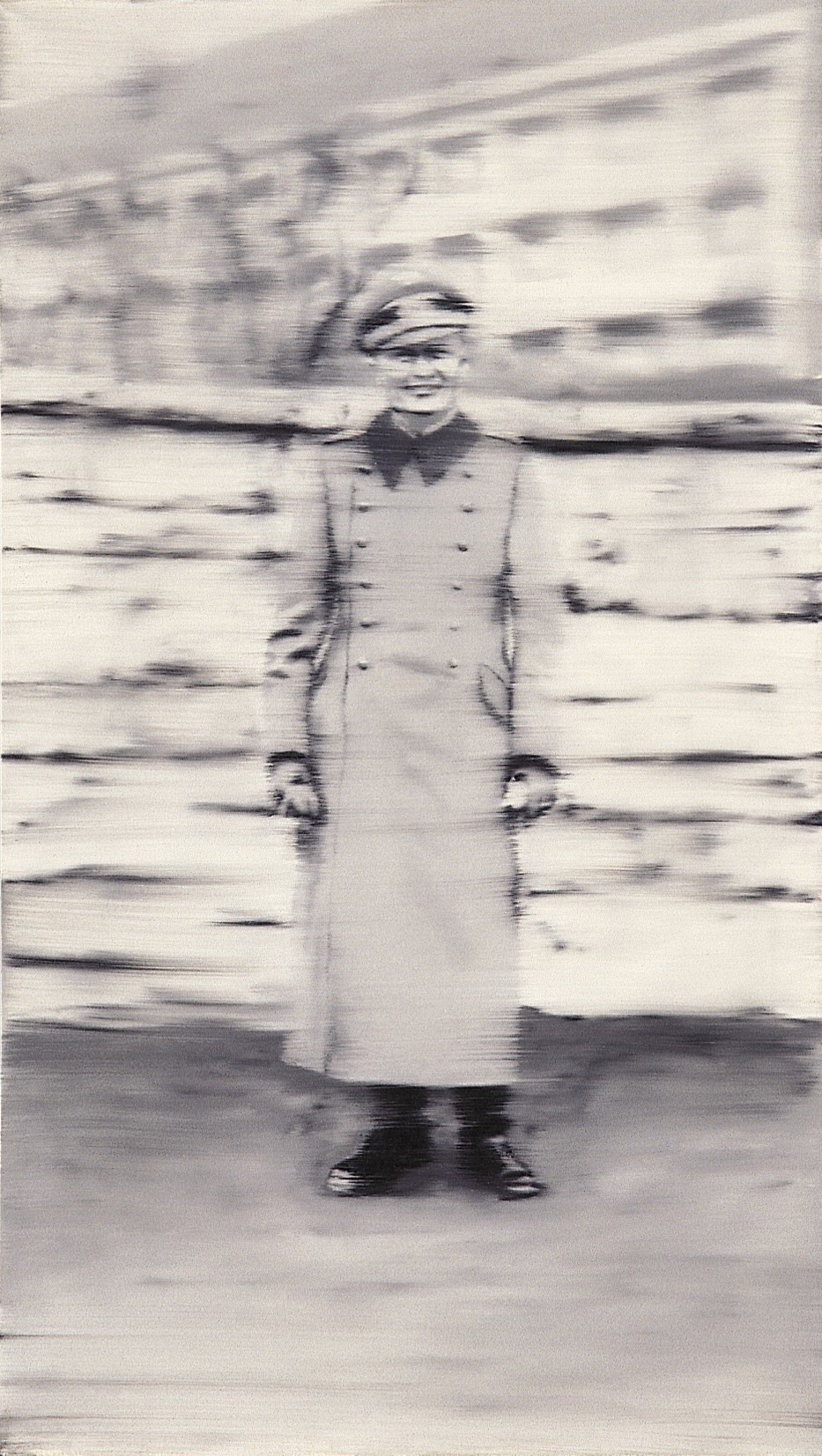
Will Self delivered a brilliant lecture on W.G. Sebald and the Holocaust in London last night. Self, who has written before about his affinity with the German writer who spent most of his life in East Anglia, suggested – if I understood him correctly – that Sebald was unique among non-Jewish writers in post-war Germany in facing the Nazi past and in particular mourning the Jews murdered in the Holocaust. Speaking beneath a screen displaying Gerhard Richter’s haunting, blurry portrait Onkel Rudi (above), he said Sebald’s novels and essays constituted a “literature of atonement” that set him apart from other post-war German writers such as Günter Grass and Martin Walser (I was slightly surprised to hear a British writer who doesn’t read German even refer to Walser, a figure who is not much known here). Perhaps most interestingly, to me at least, he suggested that the reason for this was that Sebald moved to Britain in the sixties instead of remaining in Germany.
Pen and sword

I just watched Mishima: A Life in Four Chapters, Paul Schrader’s strange 1985 biopic (if it can be called that) of the Japanese writer Yukio Mishima, who committed seppuku, or ritual suicide, in Tokyo in 1970 after a failed attempt to inspire an uprising against the post-war state by the Japanese army. I’d wanted to watch the film for a long time, mainly because I am a big fan of Paul Schrader (Taxi Driver has been one of my favourite movies since watching it in a film studies class at school) but also because Mishima is such an interesting figure. Mishima was a real-life Schrader (anti-)hero – lonely, ascetic, tortured and ultimately self-destructive. But this is also a film about the struggle to reconcile life and art – or, as Mishima put it, to achieve “the harmony of pen and sword” – which is why perhaps critics see it as Schrader’s most personal film.
 Hans Kundnani