“A cool and clear outsider’s look at the dreams and trauma of Germany’s first postwar generation.”
Stefan Aust, former editor of Spiegel and author of The Baader-Meinhof Complex
“[A] lucid and fascinating exposition of the intellectual history of the 1968 generation of the German left.”
David Aaronovitch in Prospect
“[Kundnani’s] excellent book reconstructs the political agonies of the German Left from the sixties to the present day. […] The detail is extraordinary, the tempo deliberate, the moral analysis unsparing.”
Peter E. Gordon, Harvard University, in The New Republic
“This is contemporary history at its best and will surely become a landmark study.”
Julian Preece in the Times Literary Supplement
“A very nuanced, well-informed and fair assessment of this important theme, which provides us with a fresh perspective on recent German politics and foreign policy.”
Hanns W. Maull, University of Trier
“I can hardly imagine a better written, more gripping account [of the West German student movement] than that provided by Kundnani. Precisely because he avoids polemics or judgementalism, he brings the history of 1968 and its aftermath to life.”
Bill Niven, Nottingham Trent University, in German Politics
“A very precise analysis of a time I lived intensively. I am astonished that a foreigner could have so much insight.”
Tom Koenigs, Green member of the Bundestag and former UN envoy to Afghanistan
“Utopia or Auschwitz is essential reading for understanding a generation that occupies an important place in the history of the European continent.”
Lluís Bassets, columnist, El País
“Solidly based on historical research and a slew of original interviews, Kundnani explores the unresolved – indeed, tormented – relationship of the German far Left […] to the Holocaust.”
Susie Linfield in Dissent
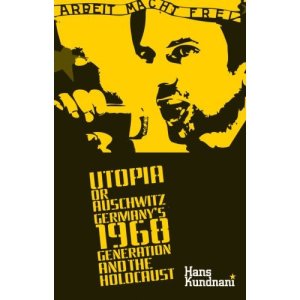
Utopia or Auschwitz: Germany’s 1968 generation and the Holocaust was published in the UK in November 2009 and the US in December 2009.
It has been reviewed in The Observer, the New Statesman, the Daily Telegraph, Prospect, the Jewish Chronicle and the Times Literary Supplement in the UK; Dissent, The New Republic, Forward and n+1 in the US; and Der Tagesspiegel in Germany. An article about the book also appeared in the Spiegel. It has also been reviewed in academic journals such as International Affairs, German Politics, Journal of Modern Jewish Studies, Critical Studies on Terrorism and Holocaust and Genocide Studies.
You can order the book at Amazon.co.uk or Amazon.com.
 Hans Kundnani
Dear Hans Kundnani,
Today my review of your wonderful book was published by Der Tagesspiegel:
http://www.tagesspiegel.de/kultur/literatur/art138,3063030
All the best
Martin Jander
Dear Hans
I’ve just finished reading Utopia or Auschwitz, I found your book fascinating and I hope that you will be writing some new books!
Quite early on in the book you mention Joachim Fest and his disputes with Ulrike Meinhoff. I wondered how much of an influence people like Fest had on the post war generation in Germany? I’m familiar with Fest’s argument that the Nazi genocide wasn’t unique, I’m interested to know if there were any groups of young German intellectuals who subscribed to Fest’s view?
I also wondered how young left wing intellectuals reacted to the release of Von Shirach and Speer in 1966, did it have any particular significance for the Achtundsechziger psychologically?
Was there a distinction between the overtly political groups and music and art scene, I was thinking of Rudi Dutschke and Kommune 1, I’ve read that the hard line political activists regarded the music and drugs scene as being rather decadent?
Regards Matt Richardson
Hi Matt –
Thanks for the kind words about Utopia or Auschwitz and for the interesting questions. In the book I discuss the Historikerstreit in the mid-eighties, which focused on exactly the question you raise about the uniqueness or otherwise of the Holocaust, but that debate was largely among West Germans who had experienced the war (Habermas, Nolte, etc.) rather than the Achtundsechziger. My sense is that there was a tension in the thinking of the 1968 generation about the Holocaust: some wanted to learn lessons from it but in the process relativised it; others saw it as unique but wanted to draw a line under it. I’ve blogged about this question here and here.
I’m not really sure how the Achtundsechziger in general reacted to the release from prison of Speer and von Schirach. But Ulrich Enzensberger, a member of Kommune 1 (and Hans Magnus Enzensberger’s brother), did mention to me that he remembered being angry on hearing that Willy Brandt had sent Speer’s daughter a bunch of flowers when her father was released. To him, this discredited Speer and illustrated what in the book I call the “continuity thesis” (i.e. the argument that the post-war Federal Republic was a continuation of the Nazi dictatorship).
You’re quite right that some of the Achtundsechziger were more political than others. Dutschke seems to have been the most austere among them – apparently he rarely watched movies or listened to music. The communards, on the other hand, could be pretty frivolous – Rainer Langhans famously said he didn’t care about the Vietnam war because he had trouble having an orgasm. However, I was always struck by just how political even the communards were. Langhans told me that for the first few months they didn’t listen to music either; instead they relentlessly interrogated each other. It seems to me that there was a seriousness and urgency about all the Achtundsechziger that distinguished them from their counterparts elsewhere in the West.
Utopia and Auschwitz? It makes me feel pretty sick that you mention Auschwitz in the same sentence as Utopia, Kundnani.