
Pen and sword

I just watched Mishima: A Life in Four Chapters, Paul Schrader’s strange 1985 biopic (if it can be called that) of the Japanese writer Yukio Mishima, who committed seppuku, or ritual suicide, in Tokyo in 1970 after a failed attempt to inspire an uprising against the post-war state by the Japanese army. I’d wanted to watch the film for a long time, mainly because I am a big fan of Paul Schrader (Taxi Driver has been one of my favourite movies since watching it in a film studies class at school) but also because Mishima is such an interesting figure. Mishima was a real-life Schrader (anti-)hero – lonely, ascetic, tortured and ultimately self-destructive. But this is also a film about the struggle to reconcile life and art – or, as Mishima put it, to achieve “the harmony of pen and sword” – which is why perhaps critics see it as Schrader’s most personal film.

Continue reading

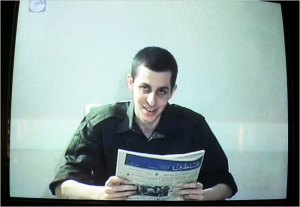
Waiting for Gilad

shalit.650.1

Israel obtained a video showing Gilad Shalit alive today in exchange for the release of 19 Palestinian women from its jails. The 23 year-old Israeli soldier was captured by Hamas in a cross-border raid in the summer of 2006 and since then there had been no evidence he was alive. Reading from a piece of paper in a voice in a breaking voice, he says he dreams of the day of his release and hopes the current government reaches a deal. Hamas is demanding the release of up to 1,000 Palestinian prisoners, including convicted terrorists, in exchange for Shalit’s release.

Continue reading

The Social Democratic tragedy

The German Social Democrats are hoping that voters will today defy all the pre-election predictions and give them a sufficient number of seats in the Bundestag to form a government with the Greens. It’s pretty unlikely: for most of the election it looked as if the Christian Democrats were way ahead, and although the Social Democrats have caught up a little, it still looks as if the best they can expect is to be the junior partner in a Christian Democrat-led grand coalition for another four years.

Continue reading

The war no one in Germany is talking about

I’ve been in Berlin for a few days now in the run-up to the general election that takes place on Sunday. One of the remarkable things about the campaign, which has been lacklustre even by German standards, is the way that the two leading candidates, the Christian Democrat chancellor Angela Merkel and the Social Democrat foreign minister Frank-Walter Steinmeier, who have shared power in a grand coalition for the last four years, have carefully avoided discussing the key issues facing Germany. Case in point: the war in Afghanistan.

Continue reading

What does Hamas want?

The Israeli historian Benny Morris is pessimistic about the prospect of a revival of the Middle East peace process, which he says is doomed to failure not because of Israeli prime minister Benjamin Netanyahu’s reluctance to freeze the expansion of settlements in the occupied territories but simply because the Palestinians have never accepted – and still refuse to accept – the idea of a two-state solution. Morris argued in an op-ed in the Guardian yesterday that neither Hamas nor even Fatah accept Israel’s right to exist as a Jewish state. He suggests that there has not been much change since eighty years ago when Palestinian leaders held the all-or-nothing view that “we will push the Zionists into the sea, or they will send us back into the desert”.

Continue reading

Germans love Obama – for now

HBhZjjbB_48899ccd0e76_Pxgen_r_700xA

The Europeans love Obama, and all of the Europeans, the Germans love him the most. That is one of the not altogether surprising but nevertheless interesting findings of the 2009 edition of Transatlantic Trends, an annual survey by the German Marshall Fund that tracks attitudes to the transatlantic relationship in Europe and the United States. According to the poll, 92% of Germans approved of President Obama, compared to only 12% who approved of President Bush this time last year – in other words, a whopping 80-point “Obama bounce”, as the authors of the report call it. (In Britain, by contrast, support for the US president jumped from 17% to 82% – a mere 65-point difference.)

Continue reading

The Zeca Schall case

Schall

The case of Zeca Schall, a 45 year-old black German politician, got a lot of publicity during the election campaign in the eastern German state of Thuringia last month. It all started when the Christian Democrats featured Schall – until then a little-known local party official – on an election billboard along with Dieter Althaus, the Christian Democrat prime minister of Thuringia. The far-right NPD called Schall a “Quotenneger” (which means either “token negro” or “token nigger”; the German word Neger is ambiguous) and Schall was given police protection. Most of the media coverage outside Germany (CNN even covered it) focused on the persistence of racism in the former East Germany, but I actually found two other aspects of the story interesting as well.

Continue reading

Springer and Israel redux

28germanyA-xlP

This is interesting in a morbid kind of way. The Springer corporation yesterday gave Israel the original blueprints for the Auschwitz death camp. Apparently, Springer, which publishes Bild, Germany’s biggest-selling tabloid, acquired them last year. Israeli prime minister Benjamin Netanyahu, who is in Europe for discussions with George Mitchell, accepted them on behalf of the country. The blueprints, which include sketches of for the original concentration camp (Auschwitz I) and the Auschwitz-Birkenau death camp (Auschwitz II) that was built later, will now be displayed in Yad Vashem.

Continue reading

How it all began

BennoOhnesorg_1

Speaking of iconic images of the West German student movement, this is one of the most famous photos in the history of the Federal Republic. The student lying on the ground is Benno Ohnesorg, who has just been shot dead by a West Berlin police officer on 2 June, 1967. The woman cradling Ohnesorg’s head is Friederike Dollinger, at the time a history student and now a schoolteacher in Munich (the taz had a nice story about her a couple of years ago). The students had been protesting against a visit to West Berlin by the Shah of Iran.

Continue reading